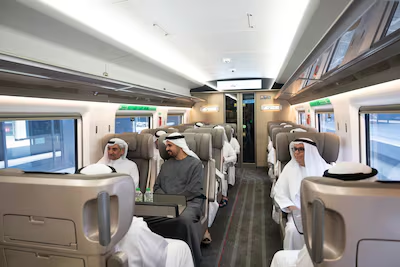



The Roads and Transport Authority reported average daily ridership of nearly 1.9 million across the emirate.
Dubai’s public transport network, shared mobility services and taxis carried around 348.1 million riders during the first half of 2026, with average daily ridership reaching nearly 1.9 million. The figures were announced by Dubai’s Roads and Transport Authority (RTA) on August 2, according to the Dubai Media Office.
The total covers the Dubai Metro, Dubai Tram, public buses, marine transport, taxis and shared mobility services, including app-based vehicles, hourly rentals and bus-on-demand. Limousines carried a further 5.7 million riders over the same six-month period.
Mattar Al Tayer, Director-General and Chairman of the Board of Executive Directors of the RTA, said the figures reflect the success of Dubai’s vision to build an integrated transport system based on sustainability and innovation, making public transport the preferred option for residents and visitors. He said the share of trips made using public transport and shared mobility rose from 6 per cent in 2006 to 22.3 per cent in 2025.
Dubai Metro Leads Public Transport Ridership in 2026
The Dubai Metro accounted for the largest share of total ridership during the first half of the year, at 39.2 per cent. Taxis followed at 25.5 per cent and public buses at 24.4 per cent. Together, the three modes made up around 89 per cent of all passenger journeys.
Metro ridership on the Red and Green lines reached roughly 136.5 million passengers over the six months. January recorded the highest monthly figure, with 73.4 million riders, while the remaining months ranged between 49 million and 66 million. Al Tayer said growing public confidence in the network had strengthened the culture of sustainable mobility across the city.
The busiest points on the network were its interchange stations. BurJuman, which serves both the Red and Green lines, topped the list with 8.4 million riders, followed by Union with 6.5 million. On the Red Line, Al Rigga recorded the highest footfall, while Sharaf DG led the Green Line.
RTA Advances Driverless Taxis and Air Taxi Launch
Al Tayer said the RTA began operating driverless taxis at the start of the year and is preparing to launch commercial air taxi services before the end of 2026, while continuing work on the Dubai Loop project.
The authority is also pressing ahead with several major transport projects. These include the 30-kilometre Metro Blue Line and the Gold Line, both aimed at expanding the rail network across the emirate, along with the phased introduction of hundreds of new Euro 6 buses to modernise the public bus fleet. Al Tayer said the results confirm the success of the RTA’s long-term policies and investments in mobility, and reinforce Dubai’s standing as a model for sustainable transport.
The RTA framed the half-year figures as evidence of a wider shift in how people move around Dubai, with residents and visitors increasingly choosing shared and public options over private cars. That shift, the authority said, supports the emirate’s broader goals on sustainability, quality of life and long-term competitiveness.
The busiest stations during the first half of 2026 were as follows:
- BurJuman, busiest interchange station, with 8.4 million riders
- Union, with 6.5 million riders
- Al Rigga, busiest on the Red Line, with 6.4 million riders
- Mall of the Emirates, with 5.2 million riders
- Business Bay, with 5 million riders
- Sharaf DG, busiest on the Green Line, with 4.9 million riders
Stay tuned for more updates and news!