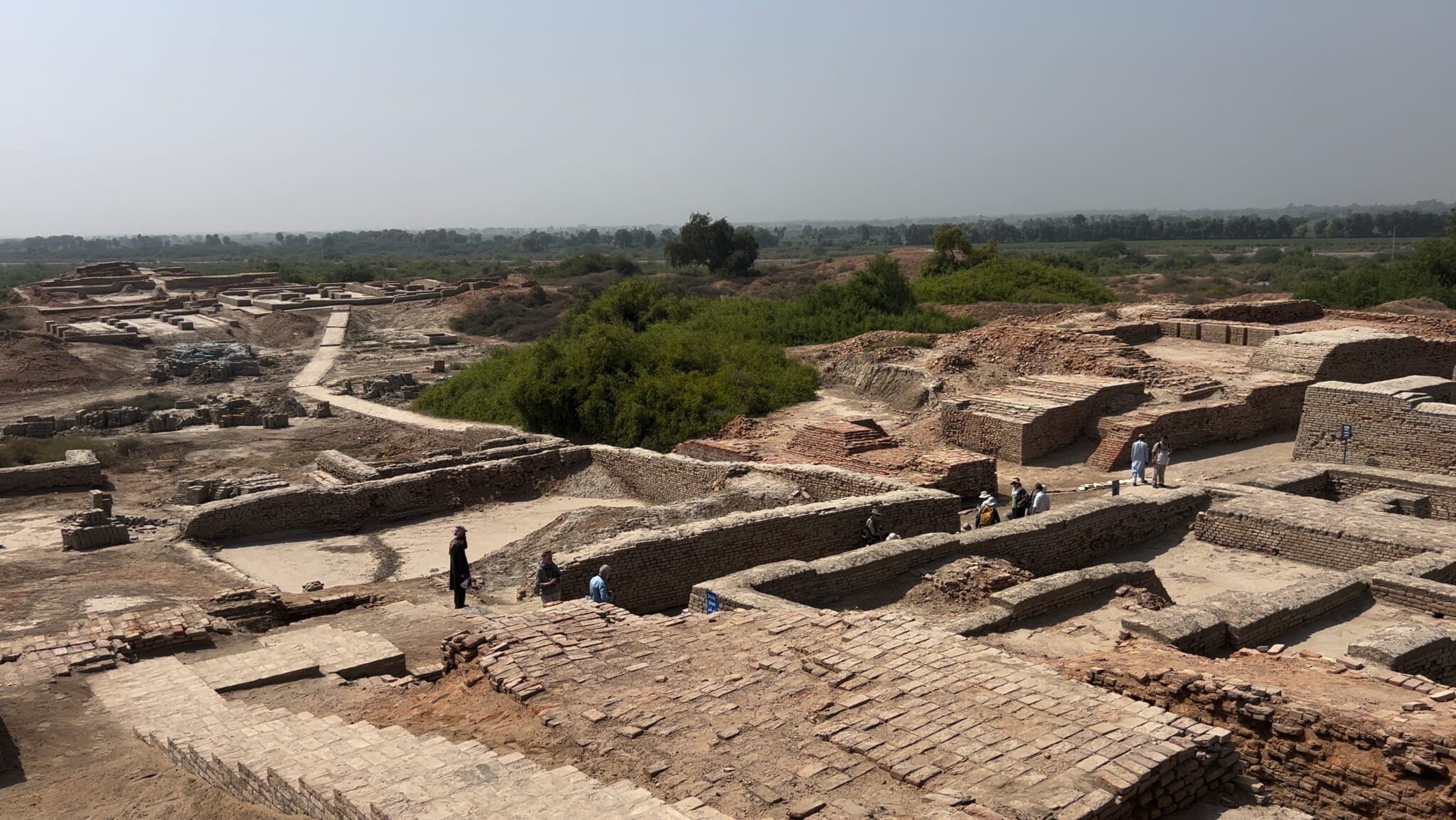
Christopher Nolan’s adaptation of The Odyssey has renewed interest in the legends of ancient Greece: heroic journeys, fallen kingdoms, civilizations whose stories still echo three thousand years later. But what if filmmakers looked east instead? What if, rather than Troy and Ithaca, they found the streets of Mohenjo-daro, one of the world’s oldest and most sophisticated cities, in what is now Pakistan?
The Opening Scene
Dawn, 2500 BCE. The camera doesn’t sweep over stone walls above the Aegean. It drops low over baked-brick rooftops, following a young engineer as she runs across the Great Bath’s edge, robes soaked, shouting for the granary keepers to wake. Overnight, the Indus has shifted its course by a few feet, enough to choke the drainage channels feeding the lower city. By midday the merchants’ quarter will flood, and with it the stores of grain that keep Mohenjo-daro’s alliance with three rival river-cities intact. She has hours, not days, to reroute water through channels no one has tested, using a system her father built and the city elders think is obsolete.
That’s not a myth. That’s a plot, and it’s built entirely from things archaeologists actually found: real drainage engineering, a real flood-prone river, real trade dependencies between city-states. No monsters required. The mystery is the civilization itself.
Troy’s ruins had to be matched to a myth that already existed. Mohenjo-daro’s ruins are the whole story: no myth has been written yet.
It was a major city of the Indus Valley Civilization, home to tens of thousands of people, laid out in precise grids with standardized fired brick and drainage systems that reached nearly every home, a level of civic planning unmatched anywhere else at the time.
What We Don’t Know
What makes it cinematically irresistible, though, is what we don’t know. The Indus script has never been deciphered. We don’t know who ruled the city, or how; the common assumption of a “priest-king” is really just one contested theory. Even its decline has competing explanations, from shifting rivers to economic collapse to climate change. Every gap is room for a screenwriter.
Hollywood already knows audiences will follow ancient history into epic territory: Greece, Rome, and Egypt have all proven that history and imagination sell together. Mohenjo-daro offers the same bargain, arguably a better one: a richly excavated backdrop paired with just enough mystery that the story doesn’t have to compete with a script everyone already knows the ending to.
This isn’t a pitch to replace Troy. It’s a reminder that ancient history wasn’t a single story unfolding in one place. While Greece and Egypt were still finding their footing, another civilization was already building planned cities and trade networks along the Indus.
The next great epic isn’t waiting to be written. It’s waiting to be rediscovered.