


Dr. Abdus Salam stands as one of the most brilliant theoretical physicists of the twentieth century. As Pakistan’s first Nobel Laureate, his ground breaking work fundamentally altered our understanding of the universe, while his lifelong devotion to uplifting science in developing nations left an indelible global footprint.
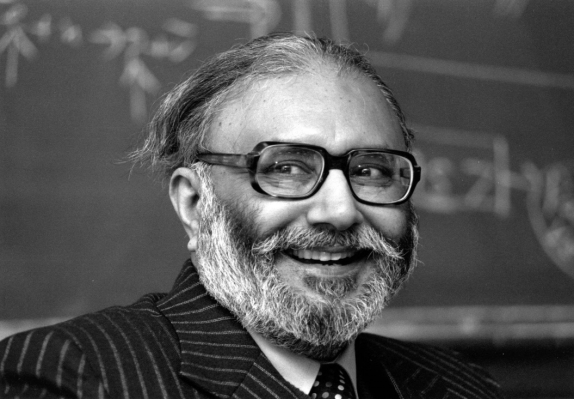
– Dr. Abdus Salam. Source: Keystone / Getty Images
Early Life and Academic Brilliance
Born on January 29, 1926, in Jhang, a small town in Punjab, Salam’s extraordinary intellect was evident from a young age. At just fourteen, he scored the highest marks ever recorded in the matriculation examination at the University of the Punjab, a feat that local folklore celebrated.
Securing a scholarship to Government College, Lahore, he excelled in mathematics and physics before winning a prestigious scholarship to St John’s College, Cambridge. In 1951, Salam completed his PhD in theoretical physics at the Cavendish Laboratory, solving a fundamental problem in quantum electrodynamics that instantly won him international acclaim.
Ground-breaking Scientific Contributions
Salam’s crowning scientific achievement came in the realm of particle physics. Throughout the 1960s, he worked alongside Steven Weinberg and Sheldon Glashow on unifying two of nature’s four fundamental forces: the electromagnetic force and the weak nuclear force.
Their mathematical framework, known as the Electroweak Theory, successfully predicted that electricity, magnetism, and certain types of radioactive decay are all manifestations of a single underlying force. This discovery became a cornerstone of the Standard Model of particle physics. For this monumental work, the trio was awarded the 1979 Nobel Prize in Physics. Notably, Salam accepted the prize in Stockholm wearing a traditional Pakistani sherwani and turban, proudly acknowledging his roots.
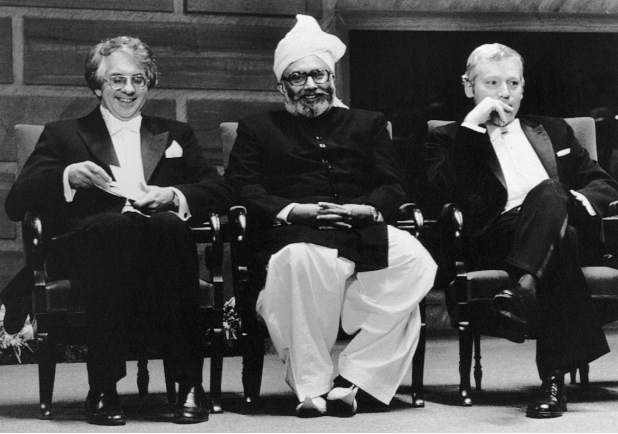
– Salam (center) at the 1979 Nobel Banquet. Source: Bettmann / Bettmann Archive
Institutional Legacy: Birth of SUPARCO and South Asia’s First Rocket
Beyond his equations, Salam was a visionary institution-builder. In 1961, he convinced the government of Pakistan to establish the Space and Upper Atmosphere Research Commission (SUPARCO), serving as its very first chairman. Under his visionary leadership, Pakistan leaped into the space age ahead of its regional neighbours.
On June 7, 1962, SUPARCO successfully launched Rehbar-I from the Sonmiani Flight Test Range near Karachi. A two-stage, solid-fuel sounding rocket carrying a scientific sodium payload, Rehbar-I soared roughly 130 kilometers into the upper atmosphere. This historic launch made Pakistan the first country in South Asia, the third in Asia and the tenth in the entire world to successfully send a vessel into space. The data collected provided vital insights into cyclone formations and weather patterns over the Arabian Sea.
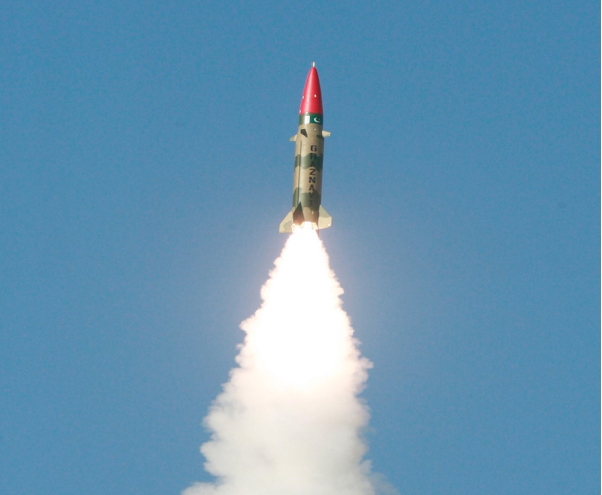
– Rehbar-I launching into the upper atmosphere. Source: Stringer Pakistan / Reuters
An Enduring Global Footprint
Salam’s ultimate legacy lies in his commitment to ending the scientific isolation of researchers in developing countries. Believing that scientific knowledge is a shared heritage of humanity, he founded the International Centre for Theoretical Physics (ICTP) in Trieste, Italy, in 1964. Renamed the Abdus Salam ICTP after his death, the institute has since provided thousands of scientists from the Global South with world-class facilities and mentorship. Dr. Abdus Salam passed away on November 21, 1996. His legacy as a premier scientific pioneer remains undeniable – a man who gave South Asia its first true reach toward the stars.