

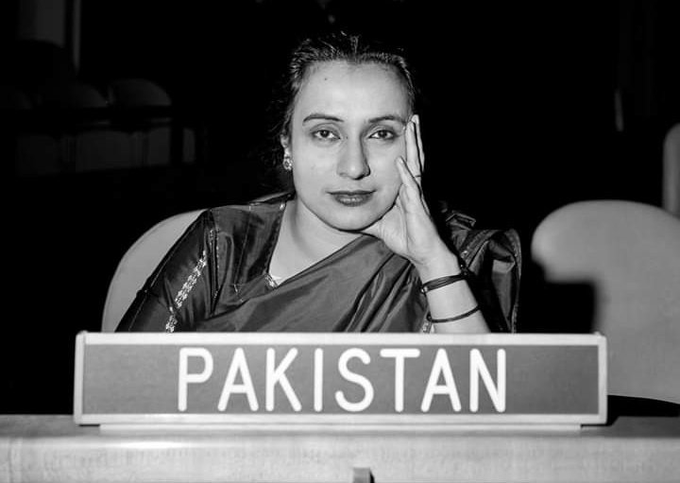
Shaista Suhrawardy Ikramullah helped shape the document that defines human rights for the world.
She helped write the document that protects the rights of every human being on earth, yet most Pakistanis have never heard her name. Begum Shaista Suhrawardy Ikramullah lived from 1915 to 2000, and her journey took her from a childhood spent in purdah all the way to the halls of the United Nations.
Along that road she left a mark on international law that still shapes how the world treats its people. Her story deserves to be remembered, and not just in Pakistan. It belongs wherever people care about dignity, equality, and the rights of women.
Born in Calcutta in 1915 into a distinguished Muslim family, she grew up with a father who believed in educating his daughter at a time when few did. That belief opened doors most women of her generation never got to walk through.
Shaista Ikramullah and the Journey From Purdah to Public Life
Her early years followed tradition, but her path kept pulling her outward. According to the government publication Hilal, she became the first Muslim woman to earn a PhD from the University of London, finishing her doctorate in 1940 with a thesis on the Urdu novel and short story. It was a remarkable feat for a woman who had started life behind the veil.
Politics found her soon after. She joined the All-India Muslim League and drew inspiration from Muhammad Ali Jinnah, who encouraged her to step into public life. When Pakistan came into being, she was there among its founding voices. She served as one of only two women in the country’s first Constituent Assembly in 1947, and she used that seat to speak for fundamental rights and for the women of the new nation.
She told her own story in From Purdah to Parliament, published in 1963. The book is still in print, and universities still assign it to students today. It stands as a quiet record of a woman who moved between two very different worlds and never lost her footing in either.
Shaista Ikramullah and the Universal Declaration of Human Rights
Her most lasting work came at the United Nations. In 1948 she sat as a delegate to the Third Committee, where nations argued over every line of the Universal Declaration of Human Rights. She stayed through 81 meetings, weighing each phrase alongside delegates from across the globe.
What mattered to her was that the language protect everyone, women included. As recorded by the constitutional platform Verfassungsblog, she pushed for the wording that described all people as free and equal to name women clearly, so no government could later leave them out. She also championed Article 16, which set out equal rights in marriage. The sister-hood magazine noted that United Nations Secretary-General António Guterres later credited her with fighting for that article to combat child marriage and forced marriage. Those protections are part of international law now, and much of that goes back to her.
Her convictions did not stay abroad. Back home she pressed for women’s inheritance rights in the Constituent Assembly, and her efforts fed into the personal laws of the early 1950s that secured them. Her list of firsts kept growing after that. She became Pakistan’s first female civil servant and its first female ambassador, serving in Morocco from 1964 to 1967. In 2002, two years after she passed, the President of Pakistan honored her with the Nishan-e-Imtiaz, the country’s highest civil award.
There is a rare symmetry in how her life unfolded. She began in seclusion and ended among the people who defined human dignity for the modern age. She helped write words that billions now live by, often without knowing her name.
Remembering Shaista Suhrawardy Ikramullah is one small way of giving her back what she earned, spoken with the pride it has always deserved.