


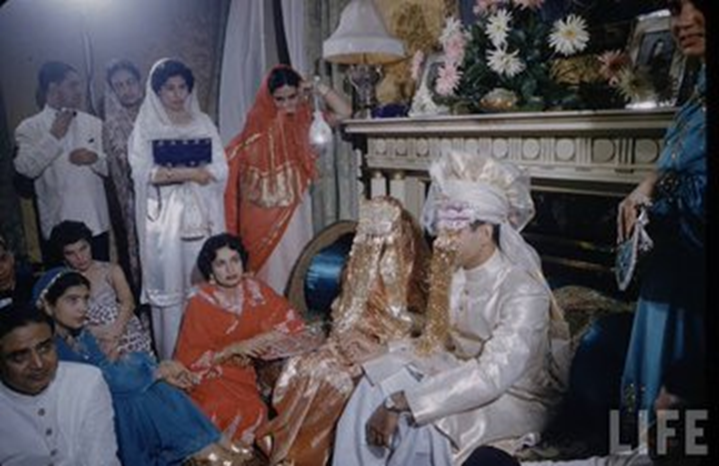
A trip down memory lane to LUMS founder Syed Babar Ali’s 1955 Washington wedding.
Some photographs do not just record a moment. They preserve a whole world. In the summer of the mid-1950s, the cameras of Life magazine slipped into a wedding at the Pakistan Embassy in Washington DC and came away with a set of color stills so rich they could each pass for a painting.
The groom was a young Lahori named Syed Babar Ali, three decades before he would found the university that carries his vision into the present day. The guest list included the Vice President of the United States. And the whole evening, caught in amber and gold, still glows.
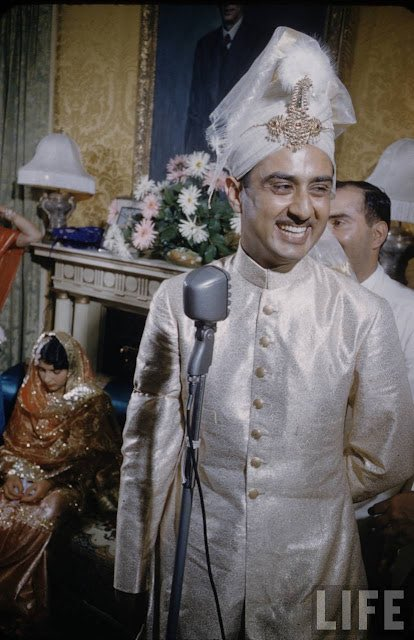
The groom, Syed Babar Ali, in a gold sherwani and a kalgi-crowned turban, addresses the gathering. Behind him, the bride waits in shimmering veil and jewels.
He was not yet the industrialist or the educator that history would remember. He was a chemical engineer in his late twenties, recently home from the University of Michigan, the eighth of nine children in a family that traced its line through the court of Maharaja Ranjit Singh. His eldest brother, Syed Amjad Ali, had just been appointed Pakistan’s Ambassador to the United States. That posting planted a young nation’s flag in the American capital and placed the family at the heart of a small, glittering world where two cultures met as equals.
When Nixon Came to the Wedding
By Babar Ali’s own account, recorded years later for The 1947 Partition Archive, he married Perwin Ali at the Ambassador’s residence in July 1955, while she was visiting from Pakistan as a tourist. Then Vice President Richard Nixon attended, and Life photographed the occasion. The surviving images are widely catalogued as 1954, a small discrepancy between the archive labels and the groom’s memory, but the scene they show is unmistakable: a Pakistani ceremony performed inside the formal rooms of an embassy, every detail of home carried across an ocean and set down without a hint of nervousness.
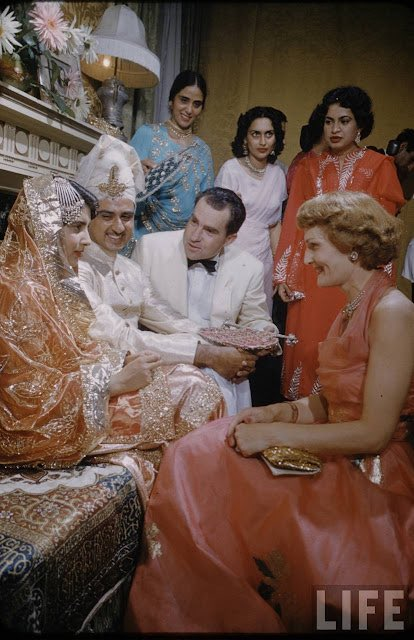
Pat Nixon, in coral, leans in as the bride and groom exchange a jeweled gift. The bride’s gold-worked silk and the easy warmth of the moment capture two worlds meeting in one room.
Look at the faces and you see the confidence of it. Pakistan was barely seven years old, still deciding what kind of country it would be, and here was a Lahori family hosting the second-highest official in America as though it were the most natural thing imaginable.
The bride sits draped in heavy gold embroidery. The guests behind her wear saris and shalwar kameez in jewel tones, diamonds at their throats. Nothing about the picture asks for permission to belong.
Old Lahore Goes to Washington
To understand why the wedding looked the way it did, picture the Lahore that produced it. This was a city of walled-city merchant dynasties and Aitchison College blazers, of families who had supplied the British Army for generations and then pivoted, almost overnight, into building the industry of a brand-new nation.
A wedding in that milieu was never only a family affair. It was a statement of arrival, stitched from Banarsi silk and inherited courtesy, performed with an instinct for occasion passed down through generations who had negotiated with kings and colonels alike.
Guests in Western evening dress and South Asian finery side by side beneath the embassy chandeliers.
Babar Ali’s own roots ran deep into that history. His ancestors, the three Fakir brothers, were trusted confidants in Ranjit Singh’s court, and family lore held that one of them helped negotiate the passage of the Koh-i-Noor diamond. So when a Lahori wedding unfolded in a Washington embassy with a future American president looking on, it was not a departure from tradition. It was tradition carried abroad with complete self-possession, the old Punjabi aristocracy meeting the new American century and finding it could hold its own.
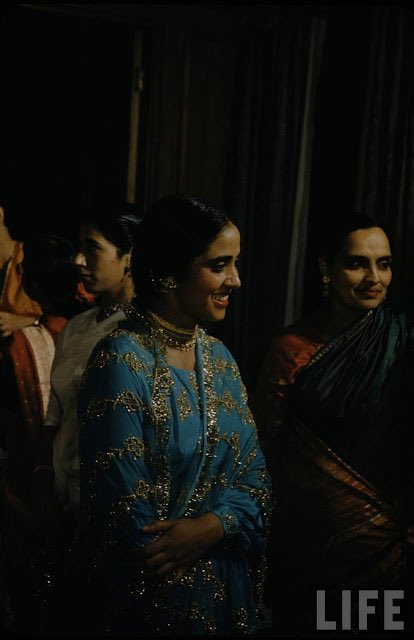
A guest in midnight-blue and gold, photographed in the warm half-light. Life’s color film turned the room’s textures, silk, brocade, candleglow, into something painterly.
The women in these frames are a study in themselves: the gold thread catching the light, the heavy chokers and bangles, the quiet poise. The men move between black bow ties and embroidered sherwanis without a second thought. It is a portrait of a class entirely at ease in two civilizations at once, neither imitating the West nor turning its back on the East.
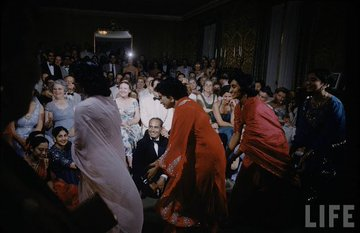
The crowd pressing close around the performers in a scene that could be unfolding in any grand Lahore haveli.
No wedding of this world would be complete without the table. The buffet stretches long and laden, pilafs (commonly known as Pilau in Pakistan) heaped high, guests serving one another with the unhurried generosity that defines a subcontinental celebration. The candelabra are silver; the food is unmistakably home.
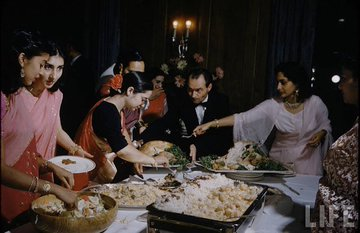
Guests gather at the dinner table. The spread of rice and roasted dishes brought the flavors of Lahore into the heart of Washington.
And then the ritual of the receiving line, that careful choreography of greeting and welcome. An officer in crisp white dress uniform extends a hand; a guest in flowing blue steps forward beneath a crystal chandelier. Each handshake is a small act of diplomacy, the kind that built bridges between a young Pakistan and the wider world long before the word networking was ever in fashion.
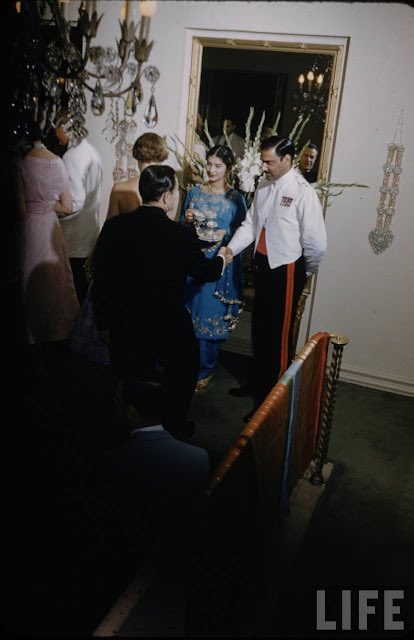
A uniformed host greets arriving guests in a moment of formal grace.
The presence that drew Life’s lenses, of course, was Richard Nixon. The Vice President and his wife Pat moved through the evening as guests rather than dignitaries, sharing in the gift exchange and the conversation. In an era when a newly independent Pakistan was finding its footing on the world stage, the image of an American Vice President at a Lahori family’s wedding spoke volumes about the connections this family had quietly built.
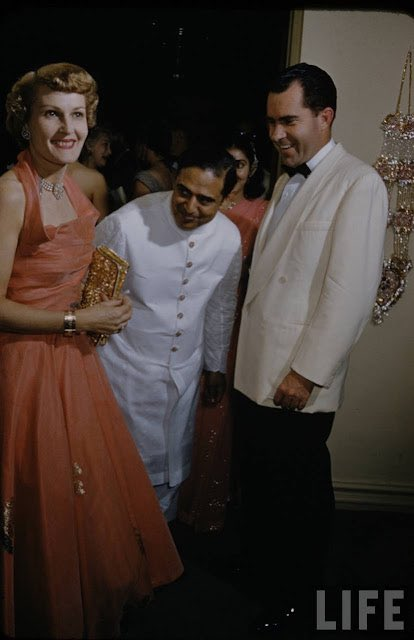
Pat Nixon and Vice President Richard Nixon stand with the groom amid the crowd, an evening that turned a private family wedding into a small moment of history.
The young groom went home and ended up making a mark for himself. After more than a decade in the family business, he traveled to Sweden and struck a partnership with Akerlund and Rausing that grew into Packages Limited. Other ventures followed, many of them joint enterprises with global names, including the company that became Nestle Pakistan. He served briefly as the country’s finance minister and spent years championing conservation as a leader of the World Wide Fund for Nature.
But the work that would outlast everything else began with a frustration. Pakistan, he believed, did not have enough skilled managers, and nowhere world-class to train them. Drawing on his own time at Harvard Business School, he set out in the early 1980s to build a university with no land and no government money, raising the funds himself. In 1985, the Lahore University of Management Sciences received its charter, and he became its first Pro-Chancellor.
Today LUMS is regarded as one of Pakistan’s most prestigious universities. What began as a single management program grew into a full institution with schools of business, science and engineering, humanities and social sciences, law, and education. The school of science and engineering carries his name. Its students, many of them on financial aid built to widen access, now sit where a young engineer once stood with nothing but an idea about what his country could become.
The wedding photographs were a glimpse of one beginning. The university is the proof of where that beginning led. Both, in their way, are portraits of the same man: a Lahori who always seemed certain the world would make room for him, and then quietly built the rooms himself.
Photographs: Life magazine archive. Wedding details drawn from Syed Babar Ali’s oral history with The 1947 Partition Archive.


