

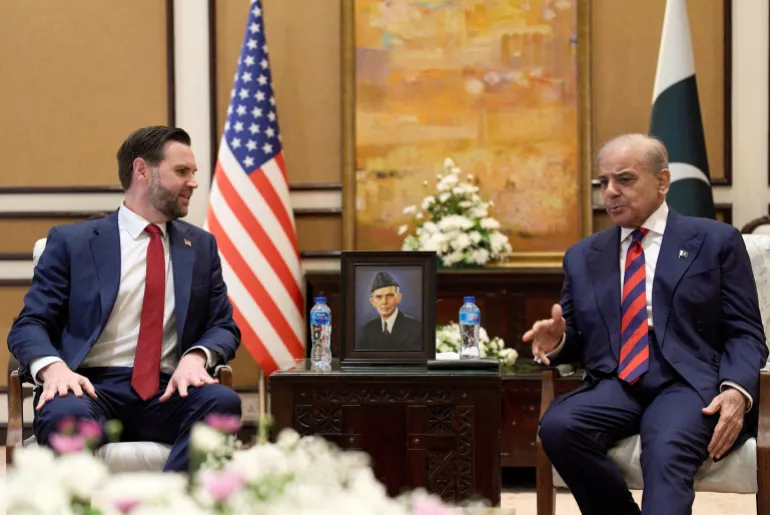
Pakistan is bracing for a second round of high-stakes negotiations between the United States and Iran in Islamabad, with the two-week ceasefire brokered by Islamabad set to expire Wednesday. The talks are expected to be led again by US Vice President JD Vance, alongside special envoy Steve Witkoff and presidential adviser Jared Kushner, the same team that led the first round on April 11 and 12.
The ceasefire, which Pakistan mediated on April 8, came after the US and Israel launched airstrikes against Iran on February 28, killing its supreme leader and a number of senior officials. Iran responded with missile and drone strikes and closed the Strait of Hormuz, severely disrupting global trade. The war is now in its eighth week.
The first round of talks in Islamabad lasted 21 hours across two days and included three separate sessions, the first indirect and the subsequent two direct. They ended without a deal or a memorandum of understanding. Vance said afterward that Iranian negotiators had moved toward the US position but not far enough, and that they needed to return to Tehran for approval before any agreement could be concluded.
Iran’s Participation in Round 2 Remains Uncertain
As of Monday, Iran had not confirmed it would send a delegation to Islamabad for the second round. The Iranian Foreign Ministry said Washington had violated the ceasefire from the outset, pointing specifically to the US naval blockade imposed on April 13 and the seizure of the Iranian-flagged container ship Touska in the Gulf of Oman. The ministry described the blockade as unlawful and said there was “no clear prospect for productive negotiations” under current conditions.
Despite the public statements, multiple reports on Monday cited senior Iranian officials indicating that a delegation was making plans to travel to Islamabad by Tuesday night. Iranian and US envoys had also separately met with Pakistani Interior Minister Mohsin Naqvi and Islamabad police to finalize security arrangements, signaling that preparations were proceeding regardless of Tehran’s public posture.
Pakistani officials acknowledged that much of the uncertainty reflected pre-negotiation positioning by both sides, and said backchannel contacts between Washington and Tehran remained active. Pakistani authorities began referring to the process as the “Islamabad process,” framing it as an ongoing diplomatic track rather than a one-off meeting.
Strait of Hormuz Remains the Central Sticking Point
The Strait of Hormuz has become the defining obstacle to any agreement. The US is insisting on full reopening of the strait as a precondition for lifting its naval blockade. Trump posted on Truth Social that the blockade “will not come off until there is a deal” and described it as costing Iran around $500 million per day.
Iran, for its part, has demanded an end to the blockade before it will engage substantively. Iranian President Masoud Pezeshkian posted on X that Iran would not submit to what he described as pressure tactics, and Iranian Parliament Speaker Mohammad Bagher Ghalibaf, who led the Iranian delegation in the first round, acknowledged a wide gap remained between the sides but said there would be “no retreat in the field of diplomacy.”
Iranian Foreign Minister Abbas Araghchi told his Pakistani counterpart Ishaq Dar by phone that Tehran was “taking all aspects into consideration” and would decide how to proceed. He previously said the two sides had been “inches away” from an agreement before the talks broke down.
Security Lockdown Across Islamabad
Pakistan has deployed more than 18,000 security personnel from the federal police and other agencies across Islamabad and Rawalpindi ahead of the talks. Between Sunday and late Monday night, 11 aircraft carrying personnel, equipment and vehicles had already landed. American advance teams were described as having largely completed their arrival, with main delegations expected by Tuesday.
Field Marshal Asim Munir, Pakistan’s army chief, traveled to Tehran last week carrying what officials described as a message from Washington. He also reportedly contacted President Trump directly, raising the Strait of Hormuz blockade as an impediment to diplomatic progress.
Pakistan’s mediation role has been central throughout. Prime Minister Shehbaz Sharif, Foreign Minister Ishaq Dar, and Munir together led the Pakistani team during the first round and are expected to continue facilitating. Pakistan’s five-point peace initiative, submitted on March 31, called for an immediate end to all hostilities and unhindered humanitarian access to the region.
Trump said Monday that a ceasefire extension was “highly unlikely” if no progress was made, adding that military action would resume if talks failed. He also said he did not feel constrained by his earlier prediction of a six-week timeline for ending the conflict. A second round of Israel-Lebanon ambassador-level talks is also scheduled in Washington this week, adding another diplomatic track running in parallel with the Islamabad process.