Legacy Check: Why Shanee Is a Must-Watch Film Even Today
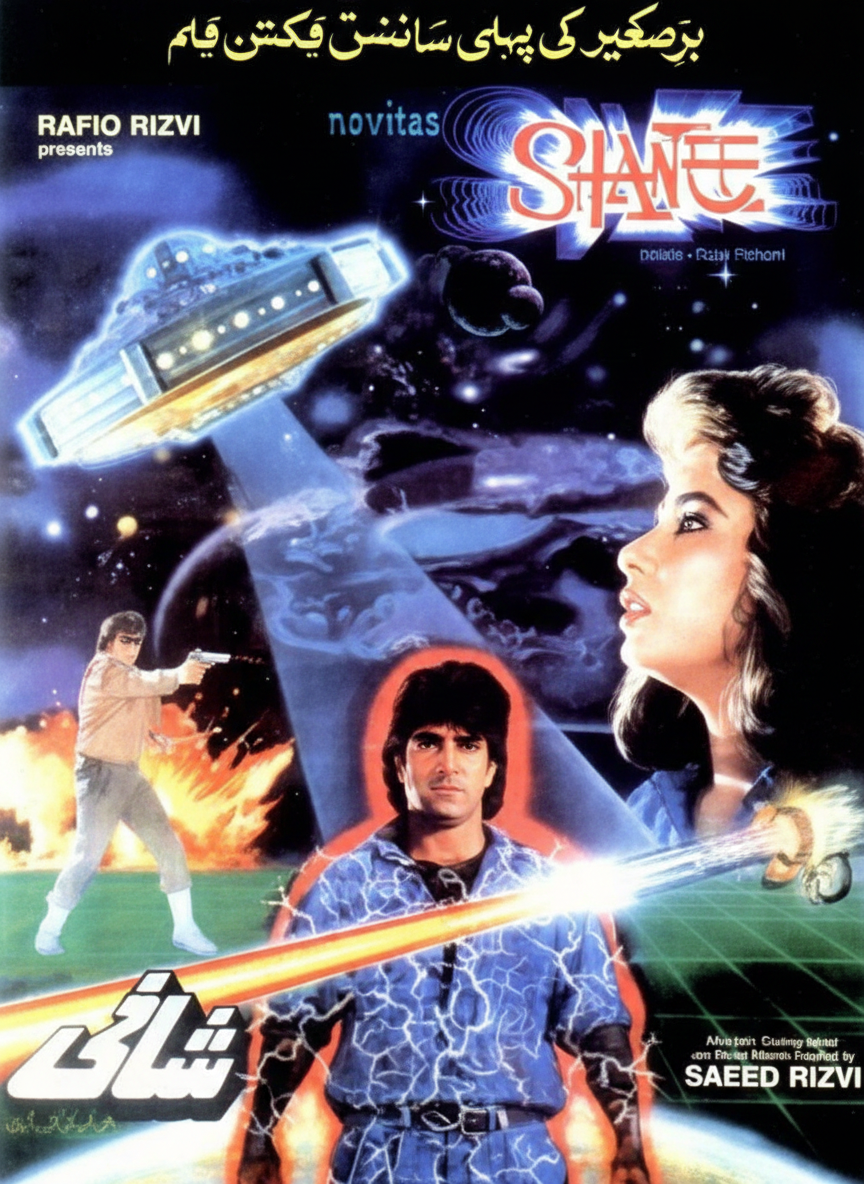
Released in 1989, Shanee stands as the subcontinent's first true science fiction feature film. Directed by visionary filmmaker Saeed Rizvi, it introduced audiences to extraterrestrial life decades before modern hits. By blending Hollywood-style special effects with a gripping story of a shapeshifting alien, Shanee became a pathbreaking achievement in Pakistani cinema.
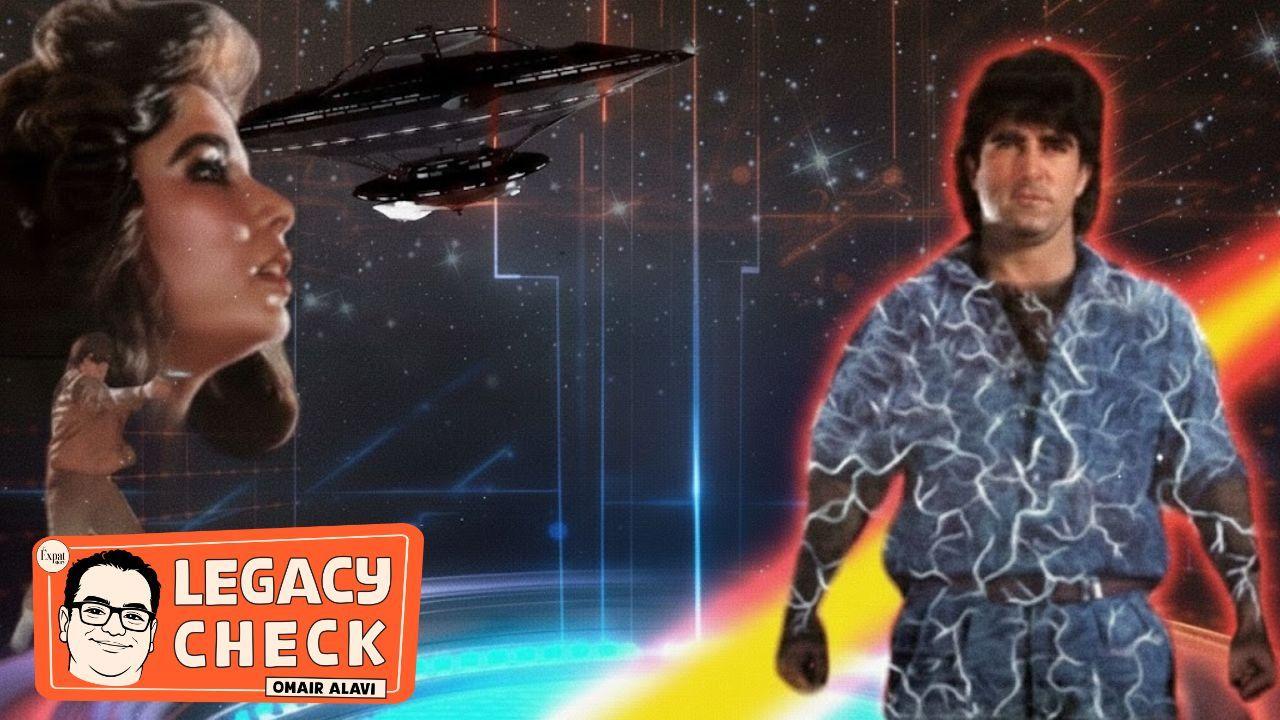
In the dead of night, a lone spacecraft drifts silently through the void, cloaked in stealth. It descends onto a barren, lifeless terrain. An alien slips out to survey the ground—but behind him, the ship powers up. Engines flare. The spacecraft lifts off. He runs. Too late. The silence returns, leaving him stranded in an unknown world.
Am I talking about Aamir Khan’s PK or Hrithik Roshan’s Koi… Mil Gaya? The scene I have described is actually the opening of Pakistani blockbuster Shanee, released in 1989, and the first feature film from the subcontinent to deal with extraterrestrials. The only difference between Shanee and the aforementioned films is that in the Pakistani film, the villagers’ commotion scares the spacecraft away but welcomes the alien, who, in an attempt to blend in, shapeshifts into one of their own.
Shanee was the first complete science fiction film of the region, though the seed had been sown earlier. Bollywood experimented with the genre in the 1960s with Mr. X in Bombay, while Pakistan had Deewana during the same decade. Released in 1987, Mr. India had sci-fi elements à la The Invisible Man, but it wasn’t a full-fledged science-fiction film.
How Shanee was conceived and executed demands a biopic of its own. In a country where Urdu films were fading, Punjabi-language films had little constructive to offer, and the number of cinemas was decreasing day by day, a young filmmaker’s bold attempt was no easy task. However, director Saeed Rizvi had a plan: to bring audiences back to cinemas and to make a film that would go down in history as something different, constructive, and everlasting. Shanee is still worth a watch for his dedication and belief in himself, and for kick-starting a journey that is still going on 37 years later.
Who is Saeed Rizvi, and what made him different from other filmmakers?
Shanee may have been Saeed Rizvi’s first film as a director and visual-effects guru, but it wasn’t his first foray into filmmaking. He belonged to a filmi family; his father, Rafiq Rizvi, was a legend of Pakistani cinema and made many iconic films in the 1950s and 1960s. Unlike other filmmakers of the era, Rafiq Rizvi—aka Baapu—didn’t treat his sons and relatives differently from others. He made them work hard so they could carve out identities of their own. He succeeded in Saeed Rizvi’s case, who took the legacy forward in his own way.
Before venturing into filmmaking, Saeed Rizvi made a name for himself as a visionary ad-film director. Over the course of his career, he made more than 2,500 TV commercials, including some of the most iconic ads of the ’70s, ’80s, and ’90s. Two such commercials—Pak Land Cement and Saadi Gardens—featured special effects that were considered superior for their time. This prompted his father to advise him to make a proper science fiction film, a genre that was unexplored in the subcontinent at the time.
“In the 1980s, I went to London and trained on the Aerial Image Optical Printer, and used that technique in a TV commercial, which was incidentally the first time anyone had done that in the subcontinent. The success of two commercials—Pak Land Cement and Saadi Gardens—that had superior special effects encouraged me to venture into films, and that’s how sci-fi adventure Shanee was conceived,” Saeed Rizvi disclosed to this scribe in an interview for a local newspaper in 2015.
He also went down memory lane to share an anecdote from those days. “When I was making Shanee in the late ’80s, people criticized me a lot and labeled me ‘the next Javed Jabbar,’ since Javed bhai had made Beyond the Last Mountain in the ’70s—in English,” he shared. “Shanee worked because the script, the treatment, and the execution were all done in the Hollywood way, and that’s why it is still remembered after so long.”
Saeed Rizvi has always had a penchant for extraterrestrial creatures, which is why he chose Shanee as the subject of his first film. He was pleased when Aamir Khan’s PK followed a similar theme some three decades later, stating that by using a similar opening scene, the filmmakers paid tribute to those who dared to be different in their time.
Shanee may not be original, but it was pathbreaking for sure
Shanee wasn’t an original film, but it was pathbreaking in many ways. It was the first Urdu feature film by an ad filmmaker—Javed Jabbar’s Beyond the Last Mountain —which was made in both English and Urdu, encouraging many other ad makers to try their hand at films. It was also the first Pakistani film to use special effects predominantly, giving it a distinctive feel. Not only did it give Sherry Malik his first break as a leading man, but it also featured renowned actors such as Mohammad Ali, Nayyar Sultana, Babra Sharif, Agha Talish, Tamanna, Rizwan Wasti, and Asif Khan to attract audiences.
Since Saeed Rizvi is a huge John Carpenter fan, he didn’t have to look far for inspiration for his first feature film. The story of Shanee was inspired by Jeff Bridges and Karen Allen’s Starman (1984), which told the story of a relationship between a recently widowed Jenny Hayden (Allen) and Starman, a non-corporeal alien who comes to Earth and clones the human body of her deceased husband, Scott (Bridges), in response to the invitation found on the golden phonograph record aboard the Voyager 2 space probe.
In Shanee, the alien comes to Earth to find a suitable replacement planet for his own kind. However, after witnessing humans fight among themselves, he decides to return and warn his species. To maintain his cover on Earth, he marries Hina (Babra Sharif) and fathers a child. He also battles the villains responsible for the death of the original Shanee, who was on the verge of exposing their human trafficking operation.
Not only was the film inspired by Starman, but its background score was also lifted from the famous animated series He-Man and the Masters of the Universe. A smart move, if you ask me, because younger audiences could relate to the music, which was used effectively in fight sequences and the title theme.
Written by Agha Nazir Kawish, based on the director’s central idea, the film had a Sholay-like feel. The villagers wore both Eastern and Western attire, the antagonist Shamsheer (Asif Khan) operated from a lair where he ran his business, and the villains regularly terrorized the villagers to maintain control. Even the hero fit the mould of a Spaghetti Western protagonist—tall, taciturn, and commanding—giving the film an international flavour.
Mohammad Ali worked in Shanee for free
Veteran actor Mohammad Ali had more or less retired by the time Shanee was conceived, yet he chose to play Dino Chacha, the village elder who stands up to Shamsheer’s tyranny and provides the villagers with a sense of safety. What many don’t know is that Mohammad Ali refused to charge a single penny for the film and even told the director that if he tried to pay him, he would not work on it.
Saeed Rizvi recalls the incident vividly. “When I approached Ali bhai for the role, he readily accepted but became angry when I brought up the matter of his fees. He told me he owed it to me, as it was my father who gave him his first break as a leading man in Aaina. He was also excited because the film targeted a younger audience, and he knew his presence would ensure the film was screened all over Pakistan without objections about a new director or a new genre.”
Sherry Malik, who played the lead character, was criticized for his “wooden” acting, but Saeed Rizvi explained that this was deliberate. Sherry was asked to emote later in the film because he was portraying an alien meant to observe rather than react. That restraint worked, and despite doing limited work afterward, Sherry immortalized himself in the minds of younger viewers.
I witnessed his ascent firsthand. In 1989, I was in Class VI at the newly inaugurated SKBZ School, where one of the junior classes included Sherry Malik’s nephew. The entire school went into panic mode the day Sherry Malik came to pick him up. Teachers assembled autograph hunters on the parade ground, where a patient Shanee Bhai signed as many autographs as he could.
Even veteran actor Nadeem Baig once confessed in an interview that the biggest regret of his career was not doing anything specifically for younger audiences. He realized their importance at an event where he received an award, yet it was Sherry Malik who drew the attention of all the youngsters present. For them, there was no one bigger than Shanee Bhai.
In 1989, Babra Sharif was competing with younger heroines, but Shanee gave her career a fresh push, effectively adding five more years to her stardom. She later worked in Saeed Rizvi’s horror film Sar Kata Insaan, which was re-released after 30 years and looked surprisingly modern and fresh, thanks to the director’s vision.
Fewer songs, no problem
Saeed Rizvi may have directed only a handful of films, but he etched his name into Pakistan’s film history with Shanee. What puzzles music aficionados is the fact that composer Farrukh Abid appeared in the film as an actor, yet there was only one shaadi song in the entire movie.
Rizvi explained that he didn’t rely on songs because they would have broken the film’s tempo, which leaned more toward the Western than the Eastern. Moreover, he had enough confidence in the script and the special effects to avoid such gimmicks.
The best print of Shanee may no longer exist—according to the director, someone in London has a DVD—but the film still lives on in the memories of those who watched it in cinemas. My biggest regret is not being able to see Shanee on the big screen. Yet knowing the director and understanding the painstaking process behind the film almost makes up for that loss.