

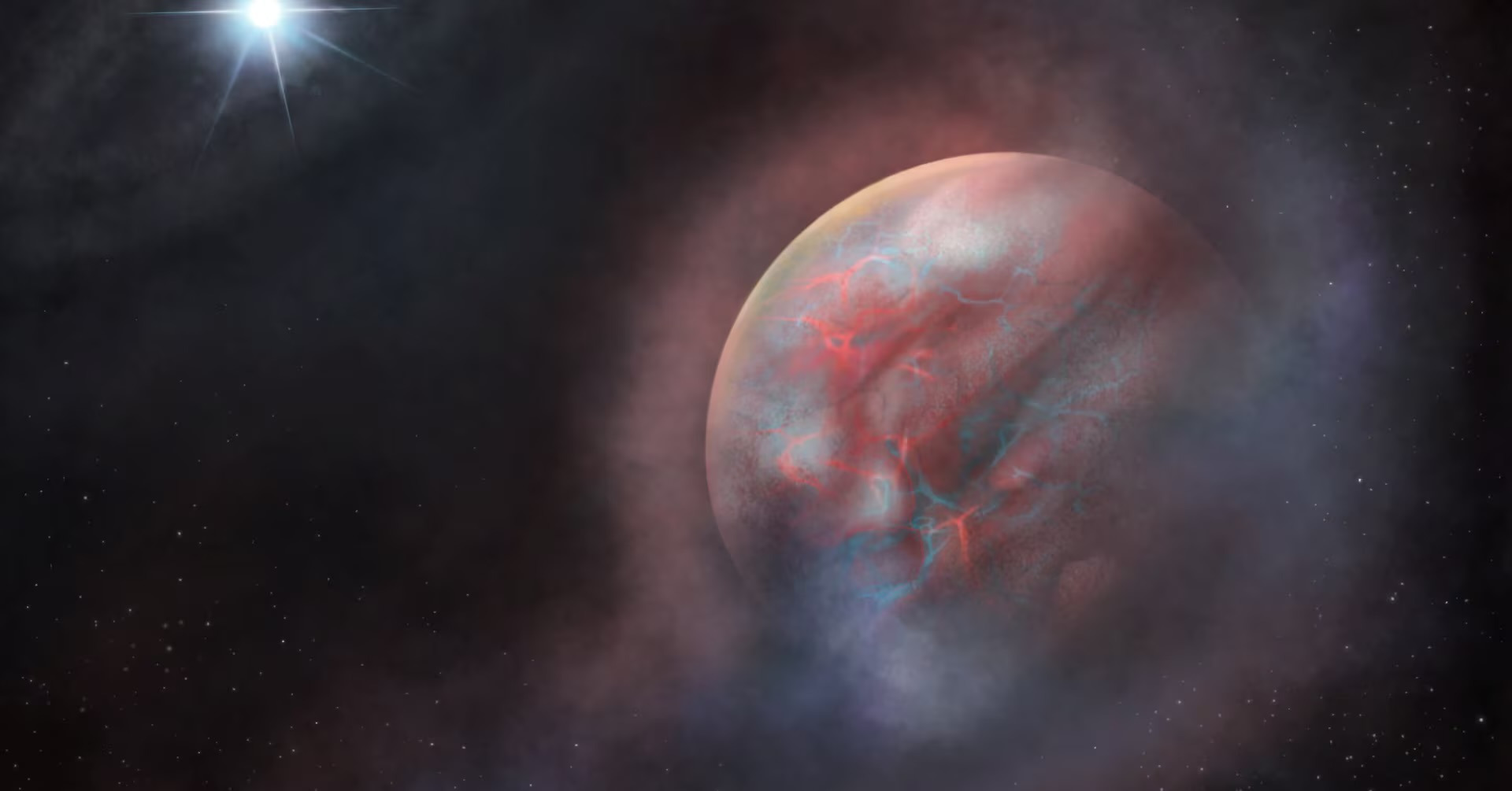
Astronomers have identified evidence for a rare type of planet that may have formed from material expelled by its own dying star. The object, described as a second-generation planet candidate, or a “phoenix planet,” is associated with the white dwarf HS 0209+0832, located roughly 270 light-years from Earth.
The discovery, reported in a study published in Nature Astronomy, provides evidence that planets may be able to form after a star has reached the end of its normal life cycle.
White dwarfs are the dense remnants left behind when stars with masses similar to the Sun exhaust their nuclear fuel and lose their outer layers. Normally, planets are expected to form during the earlier stages of a star’s evolution, from the disk of gas and dust surrounding a young star. These are known as first-generation planets.
A second-generation planet would have a different origin. It would form from material released by a star during its later evolutionary stages, after the original planetary system had already formed. Although second-generation planets have previously been proposed, the new research presents evidence for one orbiting a white dwarf.
The unusual nature of HS 0209+0832 was first noticed in archival observations from NASA’s Hubble Space Telescope. Astronomers detected several chemical elements in the white dwarf’s atmosphere that could not easily be explained by the material normally found in planetary debris.
Researchers reanalysed observations from Hubble, the Far Ultraviolet Spectroscopic Explorer (FUSE) and the Very Large Telescope. The analysis revealed unusually high concentrations of heavy elements, including zinc, copper and niobium. The white dwarf also contains very little silicon and iron compared with the material normally associated with rocky planetary bodies.
Niobium was particularly significant. According to the researchers, its abundance is consistent with elements produced through the slow neutron-capture process, or s-process, which occurs during the late stages of stellar evolution. Stars in their giant phase can produce and release these elements into surrounding space.
The researchers therefore propose that some of the material expelled by the star during its giant phase formed a disk around the resulting white dwarf. A planet may then have developed from this material, making it a second-generation world.
Observations from NASA’s Transiting Exoplanet Survey Satellite (TESS) provided additional evidence for a planetary object. TESS detected a repeating brightness variation with a period of approximately 4.4 days. Researchers interpret the signal as being consistent with a giant planet orbiting the white dwarf at a distance of about 0.04 astronomical units, or roughly 4% of the average distance between Earth and the Sun.
The candidate planet is thought to be a gas giant, potentially around the size of Jupiter. Because it is extremely close to the hot white dwarf, it receives intense radiation. Scientists calculate that this radiation could cause the planet’s atmosphere to escape into space.
Some of the escaping material may subsequently fall onto the white dwarf. This could explain why the star’s atmosphere contains the unusual collection of heavy elements detected by astronomers. NASA describes the system as a possible example of a planet being formed from material expelled during its star’s death while simultaneously losing its atmosphere back to that same stellar remnant.
The researchers emphasize that the object is a planet candidate, and further observations are needed to establish its properties and formation history more firmly. Nevertheless, the findings demonstrate that planetary formation may continue even after a star has entered its white-dwarf stage.
The discovery also offers a new perspective on the long-term evolution of planetary systems. The Sun is expected to become a white dwarf in roughly six billion years after passing through its red-giant phase. While the newly identified system does not directly predict what will happen to the Solar System, it provides astronomers with an example of how new planetary material might emerge during the death of a star.