


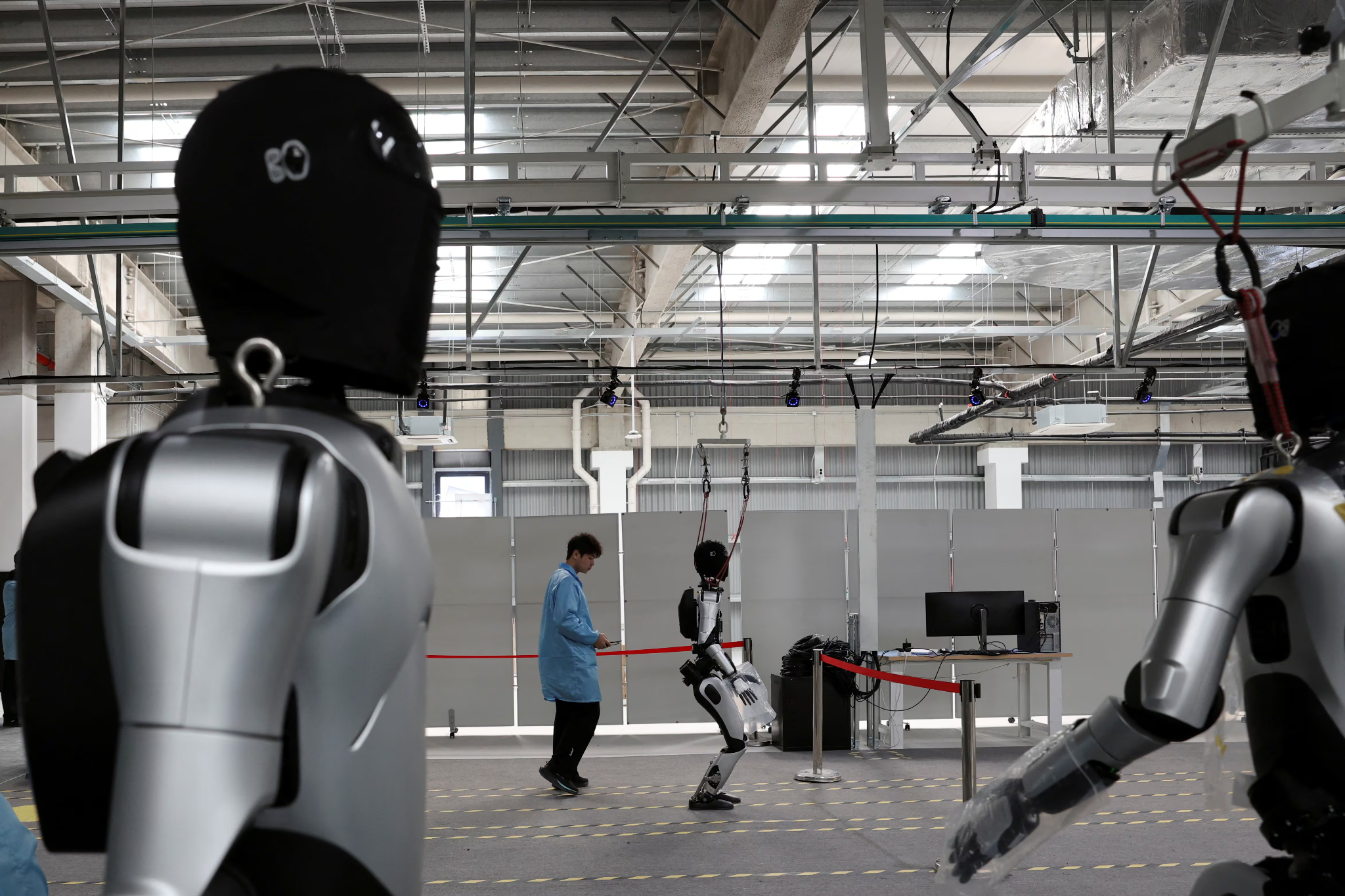
China’s robotics boom is often associated with humanoid machines that walk, run, play sports or perform demonstrations at technology events. But behind the attention-grabbing displays, a much larger transformation is already taking place inside Chinese factories. Industrial robots are being deployed at a scale that is changing how products are manufactured and how companies approach automation.
According to the International Federation of Robotics (IFR), China had around 2.03 million industrial robots operating in factories in 2024, the largest operational stock of any country. Chinese factories installed approximately 295,000 industrial robots that year, accounting for 54% of all industrial robot installations worldwide.
These machines are generally far less futuristic-looking than humanoid robots. Many are robotic arms designed for specific industrial tasks, including welding, assembly, painting, handling materials and other repetitive operations. Their widespread use means that automation is already an established part of Chinese manufacturing rather than a technology waiting for a future breakthrough.
China’s position is also becoming stronger on the production side. In 2024, Chinese robotics companies accounted for 57% of robot sales in their domestic market, exceeding the share held by foreign suppliers for the first time, according to the IFR. The figure was up from 47% in 2023.
The growth of domestic robotics manufacturing fits into a broader effort to upgrade China’s industrial sector. In May 2026, the IFR said China’s 15th Five-Year Plan for 2026–2030 places robotics and AI-powered machines at the centre of its modern industrial strategy. The plan aims to move AI applications further into the physical world, with robots playing an important role.
Demographics are another factor behind the push for automation. China’s population is ageing, while its working-age population is expected to decline over time. Automation can allow factories to increase or maintain production without relying entirely on an expanding workforce. The country’s robotics strategy is therefore connected not only to technological development but also to longer-term economic and demographic pressures.
The shift is already visible in industries such as automobiles, electronics and logistics. At the 2026 World Robot Conference in Beijing, Chinese companies demonstrated robots performing practical tasks including sorting parcels and assembling electronic products. Reuters reported that some of these machines were already being tested or deployed in real working environments rather than existing only as prototypes.
Humanoid robots are now being added to this industrial push. More than 300 companies displayed over 2,000 robotics exhibits at the 2026 World Robot Conference, according to organizers. Demonstrations included humanoid machines sorting objects, moving goods and performing assembly tasks.
However, humanoid robots remain at an earlier stage of commercial development than conventional industrial robots. Current humanoid systems can perform specific tasks, but researchers and companies are still working on improving their ability to understand unpredictable environments, manipulate different objects and operate independently for long periods. Experts at the 2026 conference noted that significant challenges remain before robots can reliably perform a broad range of tasks without human assistance.
That distinction is important when considering China’s robotics ambitions. The country does not need to wait for a fully autonomous humanoid robot before automation begins affecting manufacturing. Millions of conventional industrial robots are already operating in factories, while newer AI-powered machines are gradually being tested for more flexible tasks.
The result is a quieter form of technological change. Instead of one dramatic moment when robots suddenly replace human workers, automation is advancing through thousands of individual machines taking over specific repetitive or physically demanding jobs.
China’s robotics revolution, therefore, is not only about machines that look like people. It is increasingly about machines that work efficiently in places where people already work. That less visible development could ultimately have a greater effect on manufacturing, productivity and employment than the humanoid robots attracting most of the public attention.